Why the future of marketing is offline
AI writes half of new web content and clicks are halving. How brands marketing in Spain reach 9.5M people with measured flyers, from door to sale.
Selvin Raj
Carto.es
You are paying more every quarter to reach people who trust what they see less. You already know this. You see it in your cost per lead.
Here is why it is happening, and what we found when we went outside to look.
The internet filled up
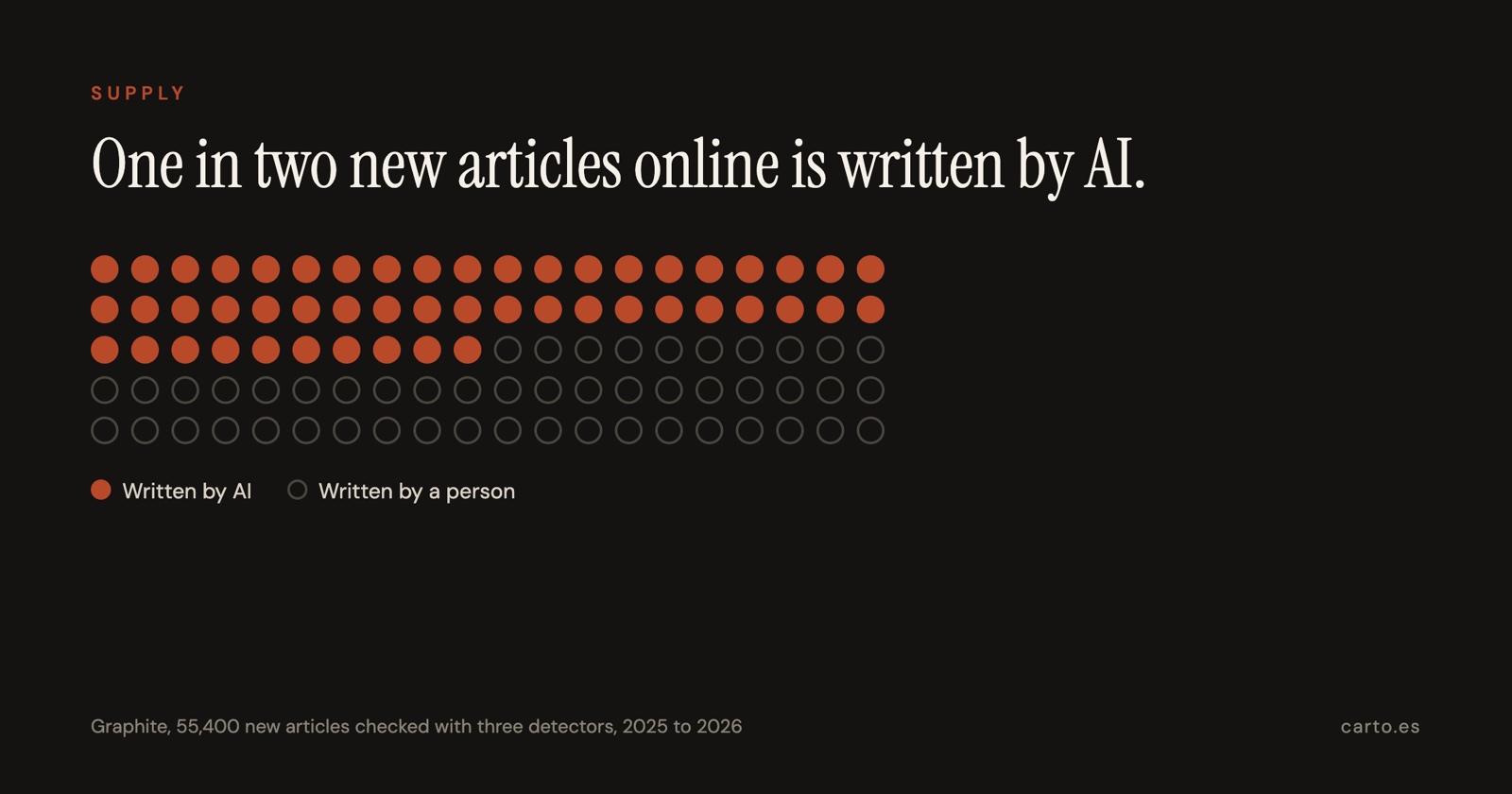
Graphite checked 55,400 new articles with three different detectors. One in two was written by AI. When something costs nothing to make, there is no limit to how much of it gets made, and your customer's attention does not grow to match.
The click is going away
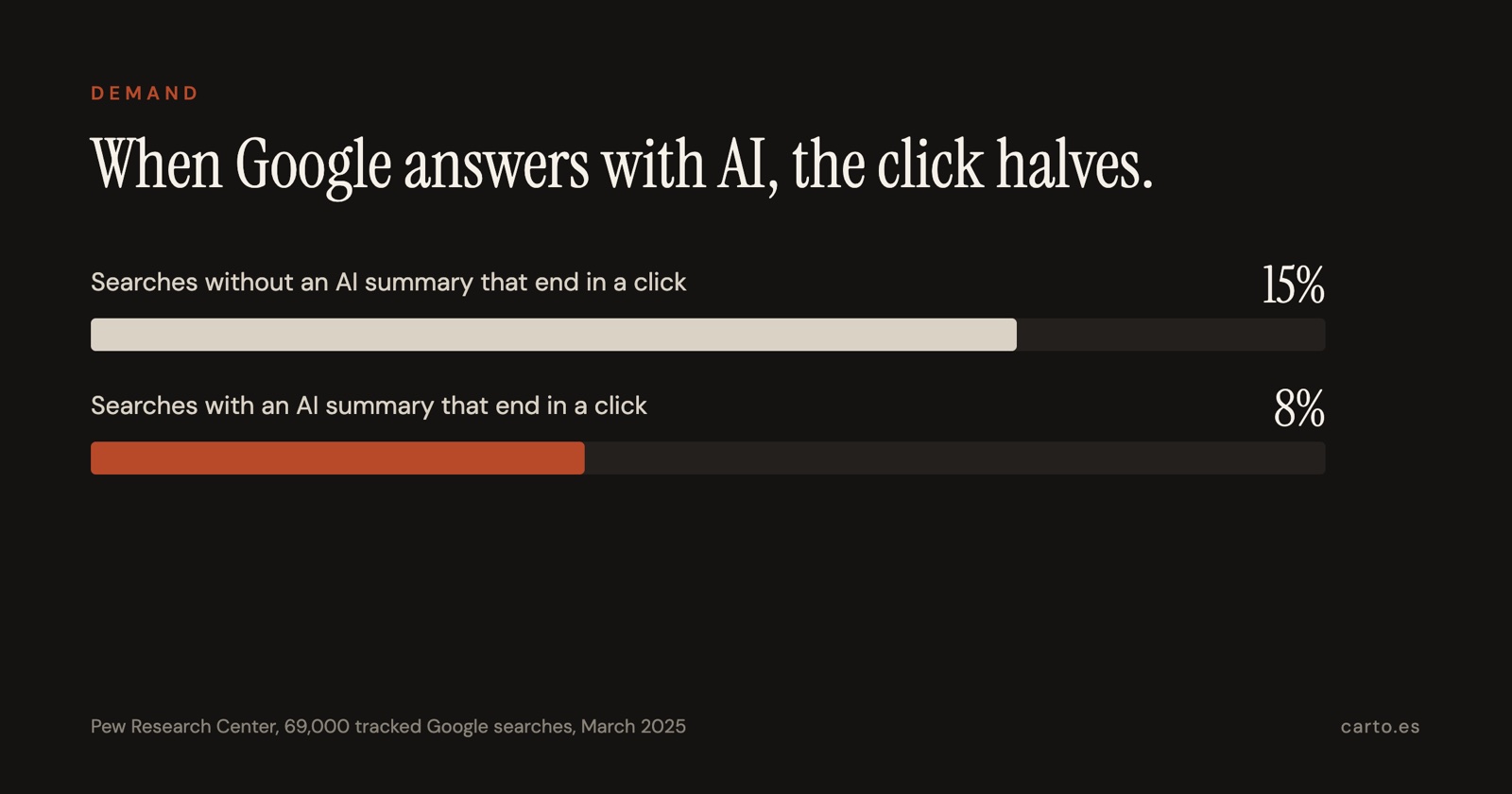
Pew Research followed 69,000 real Google searches. With an AI summary on the page, 8% ended in a click. Without it, 15%. Your content can be excellent and still never be visited.
So everyone bids for the same shrinking click
Google's average cost per click passed five dollars in 2025. Roughly a third of internet users block ads entirely, according to GWI-based estimates. If you run a D2C brand, this is the line in your P&L that keeps moving the wrong way.
Meanwhile, the letterbox is empty
In Spain, spending on door drops fell 12% last year, according to InfoAdex. Brands left. Not because paper stopped working, but because nobody could prove it did. One marketing director told me her company printed half a million flyers and later learned many went into a bin. She had an invoice and a few photos. Nothing else.
And yet paper gets what a screen no longer does. JICMAIL measures mail in the UK the way television is measured: 145 seconds of attention, 7.6 days in the home, picked up 4.6 times. The highest in five years.
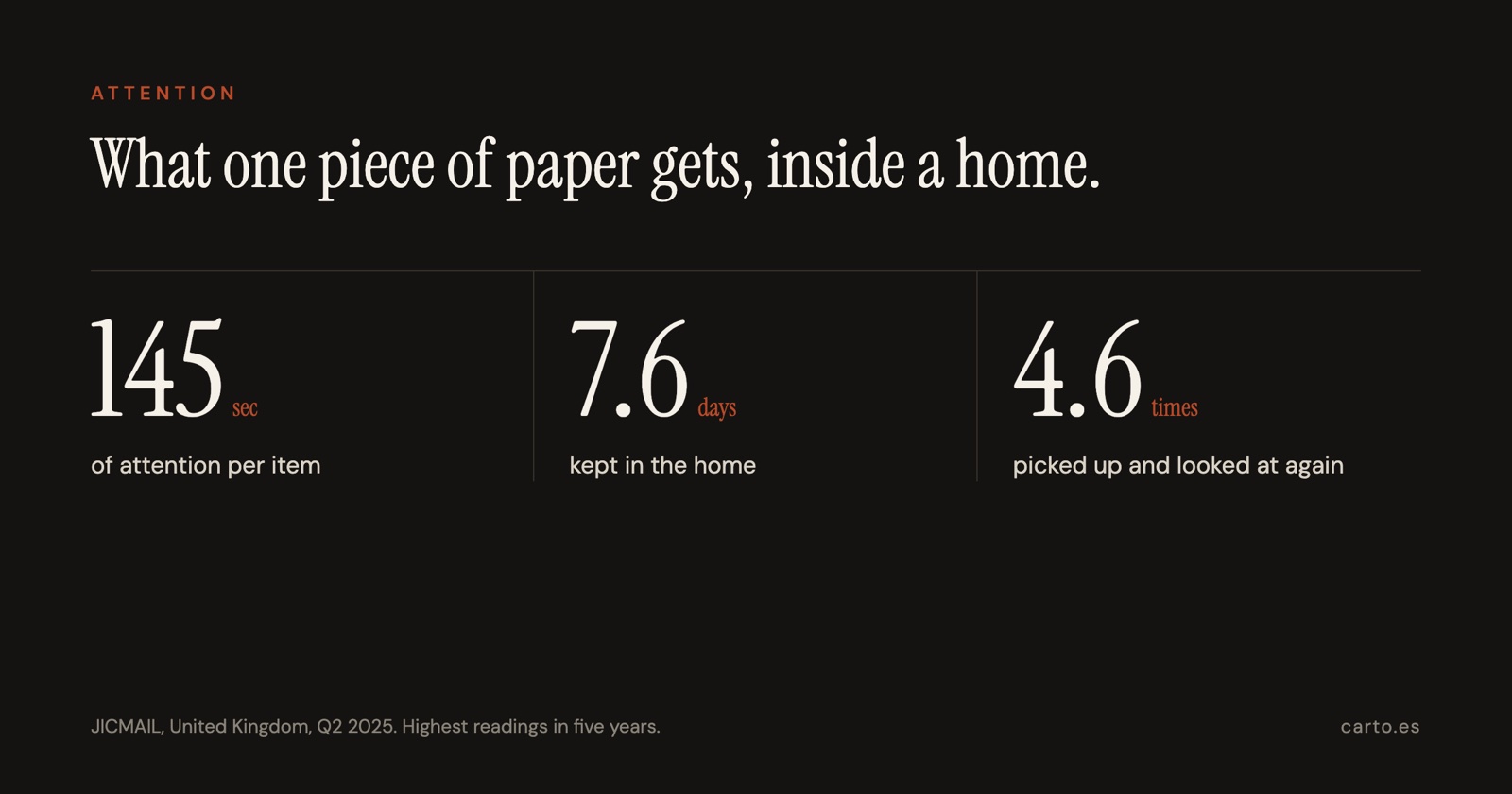
Attention moved to the quietest channel. The only thing missing was data.
So we went and got the data. From the street.
We run two services today: hand to hand distribution and door drops. Our first seven campaigns were a mix of both, from a festival in Cádiz to a museum off the Ramblas to a studio in Poblenou.
This is the part I have not seen anyone else do. Every crew is tracked by GPS. Every zone has photo proof. Every flyer carries an offer and a code, so we know which street answered, and at what hour. And we match each route to Spain's cadastral record, building by building, so we can tell you how many mailboxes were actually reached. Not estimated. Counted.
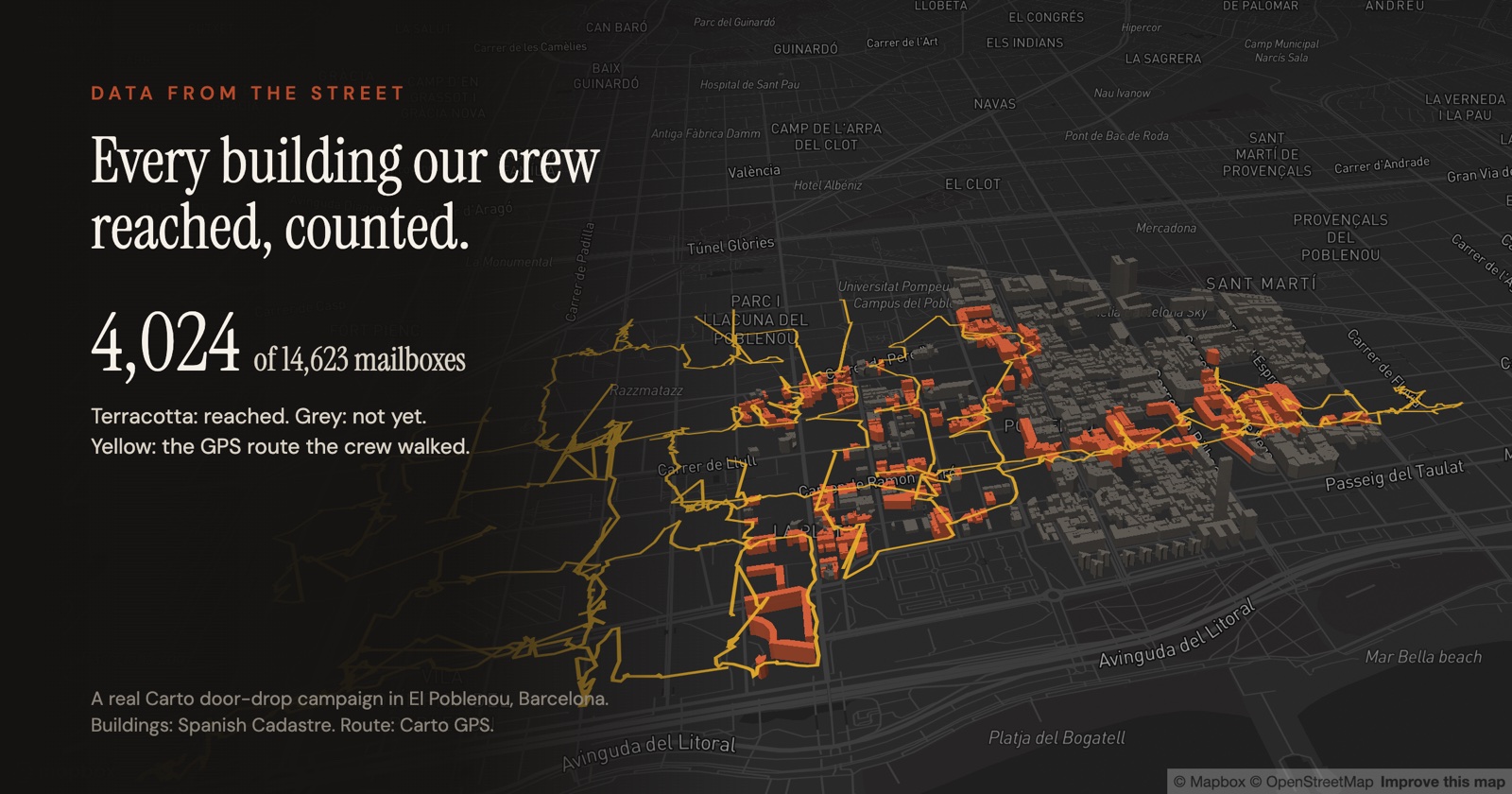
The image above is a real Carto campaign, not a mock-up.
And the trail does not stop at the door. Clients install one line on their website, the same way they install Google Analytics, and our pixel follows the response through to the booking, the sign-up or the sale. No cookies, no personal data. So for the first time an offline campaign is trackable from the hand or the letterbox all the way to the purchase, in the same dashboard, in real time.
Route, proof, response, sale. One line of sight.
Across our first seven campaigns, measured response has been between 3.3% and 4.8%. One campaign was still receiving responses weeks after the last flyer.
That is data no model can generate. Someone has to carry it back from a real street.
Seven campaigns made us ready to scale
Those first campaigns were the test. Planning routes, requesting municipal permits, recruiting and tracking crews, printing, measuring: every part of the operation now runs on the platform, and it works the same way in any city. We have mapped the ten largest cities in Spain, 3.7 million mailboxes and 9.5 million people: Madrid, Barcelona, Valencia, Sevilla, Zaragoza, Málaga, Murcia, Palma, Las Palmas and Alicante.
So the question is now yours. Do you want to saturate a neighbourhood, a whole city, or all ten at once? Simulate it on the map.
Spain is the start. The technology is built and ready to scale, and we will be taking it to the rest of the EU, the UK and the US very soon.
Why AI makes this stronger
AI will keep making digital content cheaper. A flyer in a real hand cannot be generated. It has to be taken there. That cost is exactly what makes it worth something.
Today it is flyers. Tomorrow it may not be.
The flyer is the first thing we carry, not the last. What we are really building is a measured way to put something in front of a real person in a real place. In a few years that could be digital material delivered by a robot, or something none of us has thought of yet.
Sidewalk robots have already made more than ten million deliveries. Humanoids are coming next. We are designing Carto for hybrid crews: robots carrying volume along planned routes, people doing what people do better, reading a street and handing something over with a smile. The platform that tracks our crews today is the one those robots will plug into. It will arrive city by city, with councils, not around them.
If you run marketing, try one thing
Take your cost per lead and how many of ten leads buy. Two numbers. Our calculator turns them into what a customer costs you through a letterbox, next to what you pay today. If it does not beat your digital number, you have lost one minute. And once you run a campaign, you do not have to take our word for it: the pixel shows you the sales.
Calculate your cost per customer
Frequently asked questions
How can a brand advertise offline in Spain and measure the result?
With Carto, every flyer campaign in Spain is tracked like a digital channel. Crews carry GPS, every zone has photo proof, every flyer carries an offer and a code, and a pixel on your website follows the response through to the sale. You see all of it in one dashboard while the campaign is still on the street.
Which Spanish cities can I cover?
The ten largest: Madrid, Barcelona, Valencia, Sevilla, Zaragoza, Málaga, Murcia, Palma, Las Palmas and Alicante. Together that is 3.7 million mailboxes and 9.5 million people. You can book a single neighbourhood, a full city or all ten.
What response rate do flyer campaigns get in Spain?
In our first seven campaigns, measured response has been between 3.3% and 4.8%. A door drop in Barcelona measured 4.1%. The result depends on the offer and the zone, which is why we measure every campaign instead of quoting an industry average.
Do I need a permit to distribute flyers in Spain?
Door drops into mailboxes need no municipal permit; crews simply respect mailboxes marked as not accepting advertising. Hand to hand distribution in the street usually needs a permit from the city council, and we request it for you.
How much does a flyer campaign in Spain cost?
Our smallest campaigns are 25,000 mailboxes for a door drop or 10,000 flyers hand to hand, from about 18 cents per mailbox with printing, GPS proof and the dashboard included. The calculator turns that into your cost per customer in one minute.
Related CARTO pages
Ready to see real results?
Book a free consultation and we'll design a campaign that reaches your customers where they actually live and work.
Book a free consultation →